Bench Notes › Articles › Repair
Article · 1 min readWhy That RCA Cable Picks Up Noise Across the Room.
By Thomas Popp · Oct 7, 2026
The hum wasn't there at the bench, and now it's there on the playback. Nothing about the equipment changed same source, same destination, same cable. The difference is the room: a long unbalanced RCA run across a real room is an antenna, and every power cable, dimmer, and wall wart it passes adds its signature to your audio. The cable didn't go bad between the bench and the set. It was always an antenna. The bench just didn't have anything for it to hear.
Why unbalanced hears everything
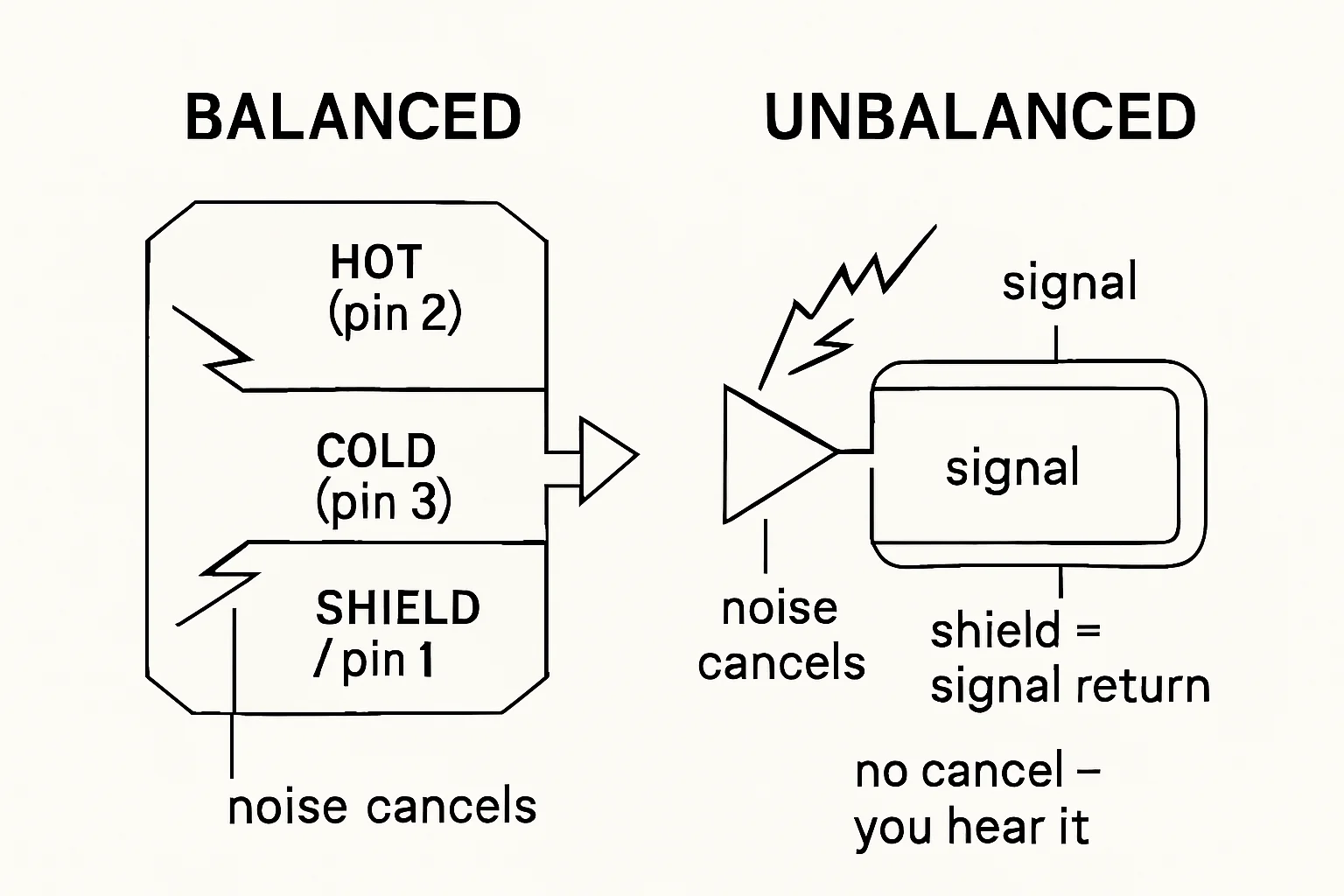
An RCA cable carries each channel as a single signal conductor plus a shield. There is no paired conductor for the receiver to compare against - whatever voltage the conductor picks up from the environment becomes part of the signal, permanently. A balanced XLR run, by contrast, carries the signal on a hot and cold pair: any noise the cable picks up lands equally on both conductors, and the receiver subtracts them, cancelling the common noise out. The unbalanced cable has no such defense, so the noise stays.
And the longer the run, the more noise it collects. Every foot of cable is more antenna - more exposure to the electromagnetic environment of the room. This is the part that fools people: the same RCA cable that was silent on a two-foot bench patch becomes a hum collector on a room-length run, and the instinct is to blame the cable. The cable is fine. It's doing exactly what an unbalanced cable does at that length in that environment.
Routing rules that actually work
If the RCA has to cross the room, the first move is to shorten the unbalanced run. Keep it as short as the layout allows - and note the deliberate absence of a number here: specific maximum-length figures are common field guidance but not vault-verified, so the bench rule is simply shorter is always better, and every foot you cut is less antenna.
Then route it away from mains cable and power supplies. Power cables, dimmers, wall warts, and distribution strips are the loudest things in the room electromagnetically, and an unbalanced conductor running parallel to them soaks it up. Where the RCA must cross a power cable, cross at right angles - a perpendicular crossing minimizes the coupling, while a parallel run maximizes it. Never run unbalanced audio parallel to mains for any distance. Keep the run clear of lighting dimmers too; they chop the mains waveform and radiate broadband hash that an RCA picks up beautifully.
The real fix: convert to balanced
Routing discipline helps, but it has limits - sometimes the layout forces a long run through a noisy room, and no amount of right-angle crossing fixes physics. The real fix is to get the long part of the run off the unbalanced cable entirely: run balanced XLR from the source to near the destination and only adapt to RCA at the last short hop. The long run gets the noise-rejecting hot-and-cold pair, the short unbalanced tail picks up almost nothing, and the hum problem disappears by architecture rather than by luck.
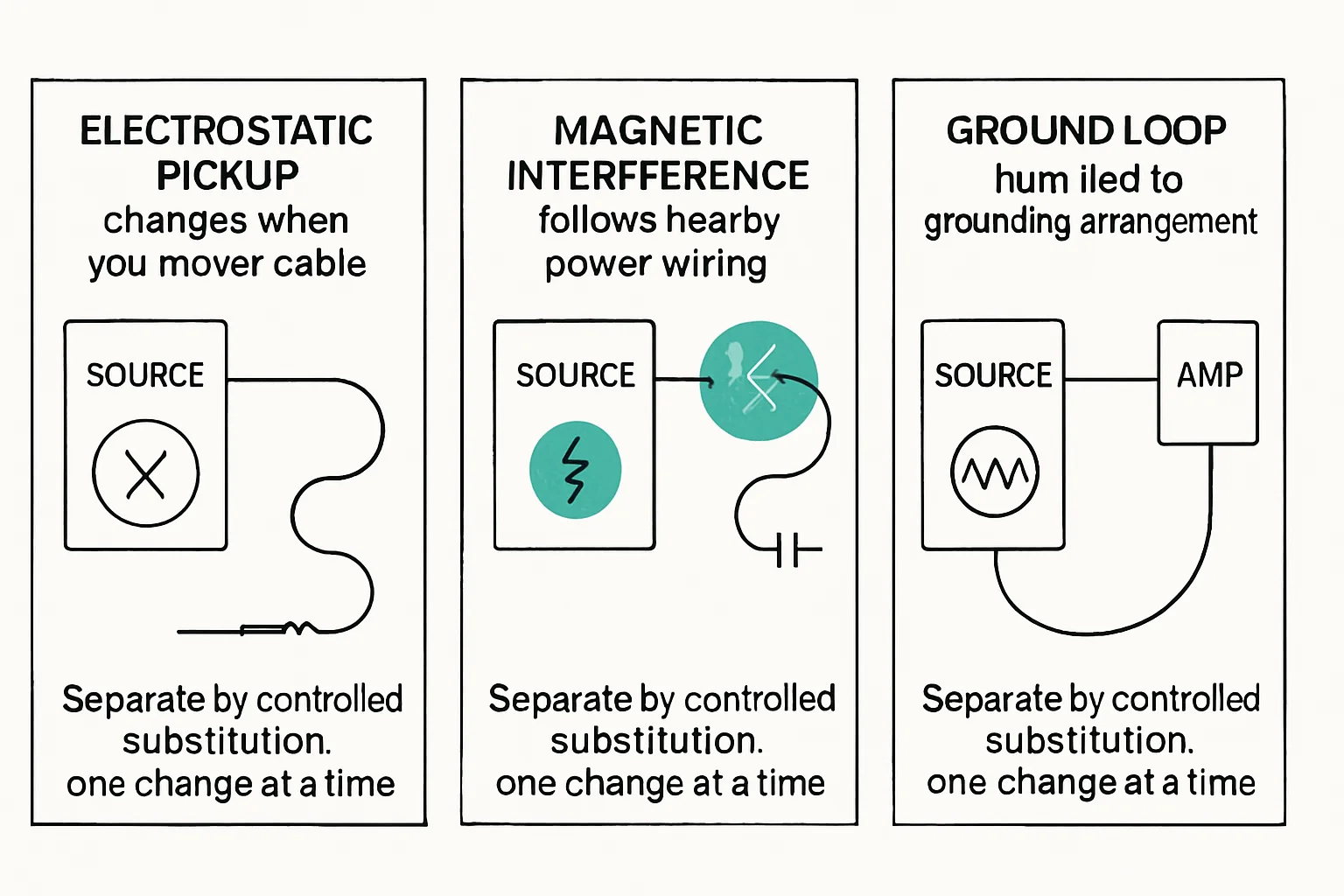
Where you can't go balanced, an isolation box is the other standard answer - it breaks the path the noise rides in on. That matters because some of what looks like "RCA noise" isn't picked up by the cable at all; it's a ground loop, a difference in ground potential between source and destination that flows through the shield and shows up as hum. No rerouting fixes that, and no replacement cable fixes that either.
The ground-loop tell
Here's the diagnostic the newsletter gave you: if the hum changes when you touch the connector shells or the source device, suspect a ground loop. Touching the shells changes the grounding geometry - your body becomes part of the ground path - and if the hum's character or level shifts, the problem is grounding and routing, not a bad cable. That's a different fix (isolation, grounding, breaking the loop) and a different shopping list. Swapping in a fresh RCA and hearing the same hum is the confirmation: the cable was never the problem.
Bench takeaway: A long RCA run is an antenna by construction - shorten it, keep it clear of mains, cross power at right angles, and when the run has to be long, put the distance on balanced cable instead.
Pinout reference
| Pin | Carries |
|---|---|
| C | Center · signal |
| SH | Shell · shield / return |
| Pin | Carries |
|---|---|
| L | Line (hot) |
| N | Neutral |
| E | Earth / ground |
Related
The Buzz You Hear Might Not Be Coming From the Microphone · Why Your Connector Keeps Coming Loose · Course: Build a basic XLR cable