Bench Notes › Articles › Reference
Article · 2 min readTRS Does Not Automatically Mean Stereo.
By Thomas Popp · Oct 7, 2026

A 1/4-inch TRS plug has three contacts - tip, ring, sleeve - and your brain completes the pattern: three contacts, three wires, must be stereo. It is one of the most expensive assumptions in audio wiring. The plug is just a shell. Three completely different jobs share the exact same connector, and the wiring inside decides what it carries.
The same plug, three different jobs
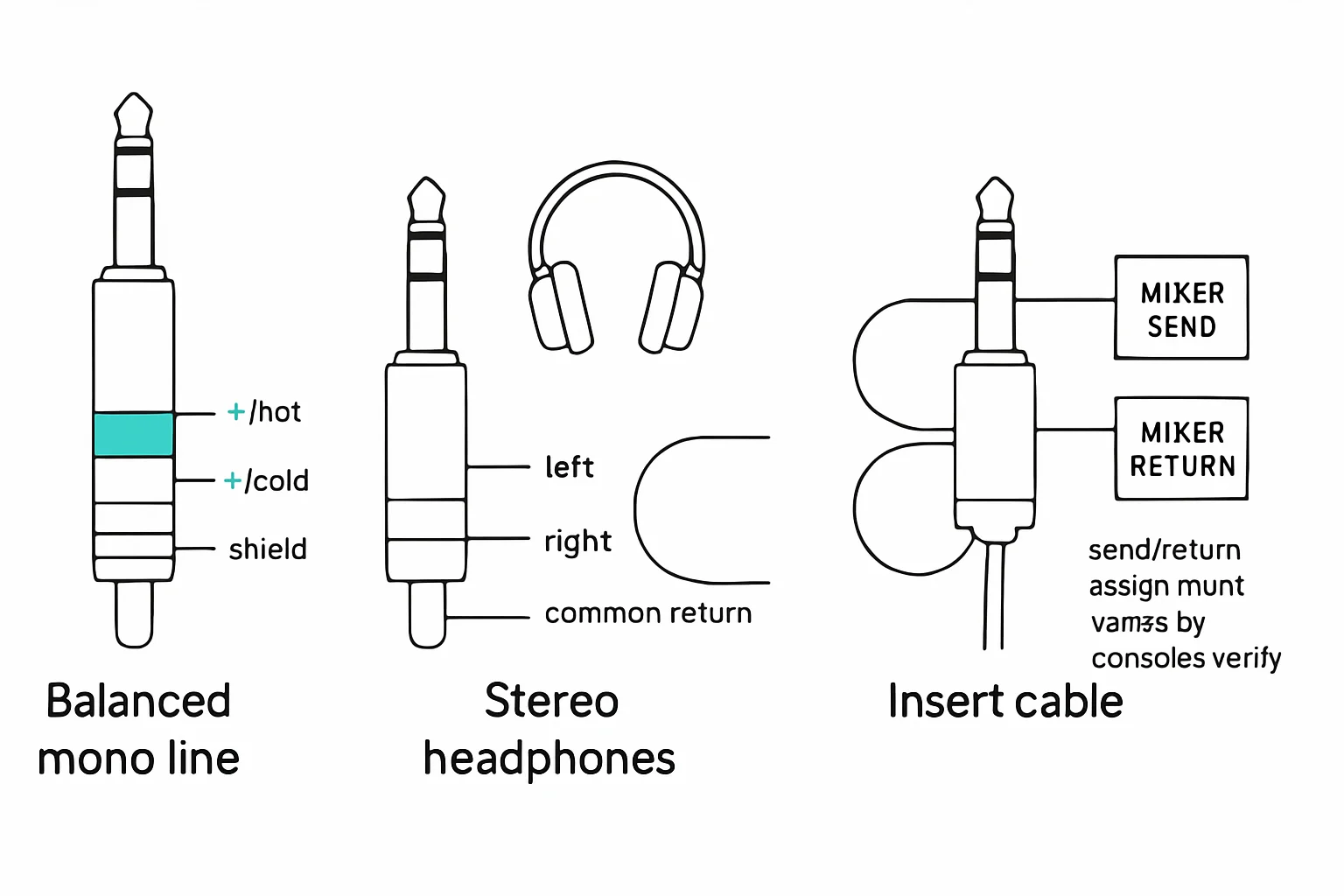
On the bench you will meet all three. A 1/4-inch balanced mono line uses tip for hot, ring for cold, and sleeve for ground - the standard balanced configuration (vault catalog: PB-TRS14-TRS14). A 3.5mm TRS is the one most people picture: unbalanced stereo, tip carrying left, ring carrying right, sleeve as ground (vault catalog:
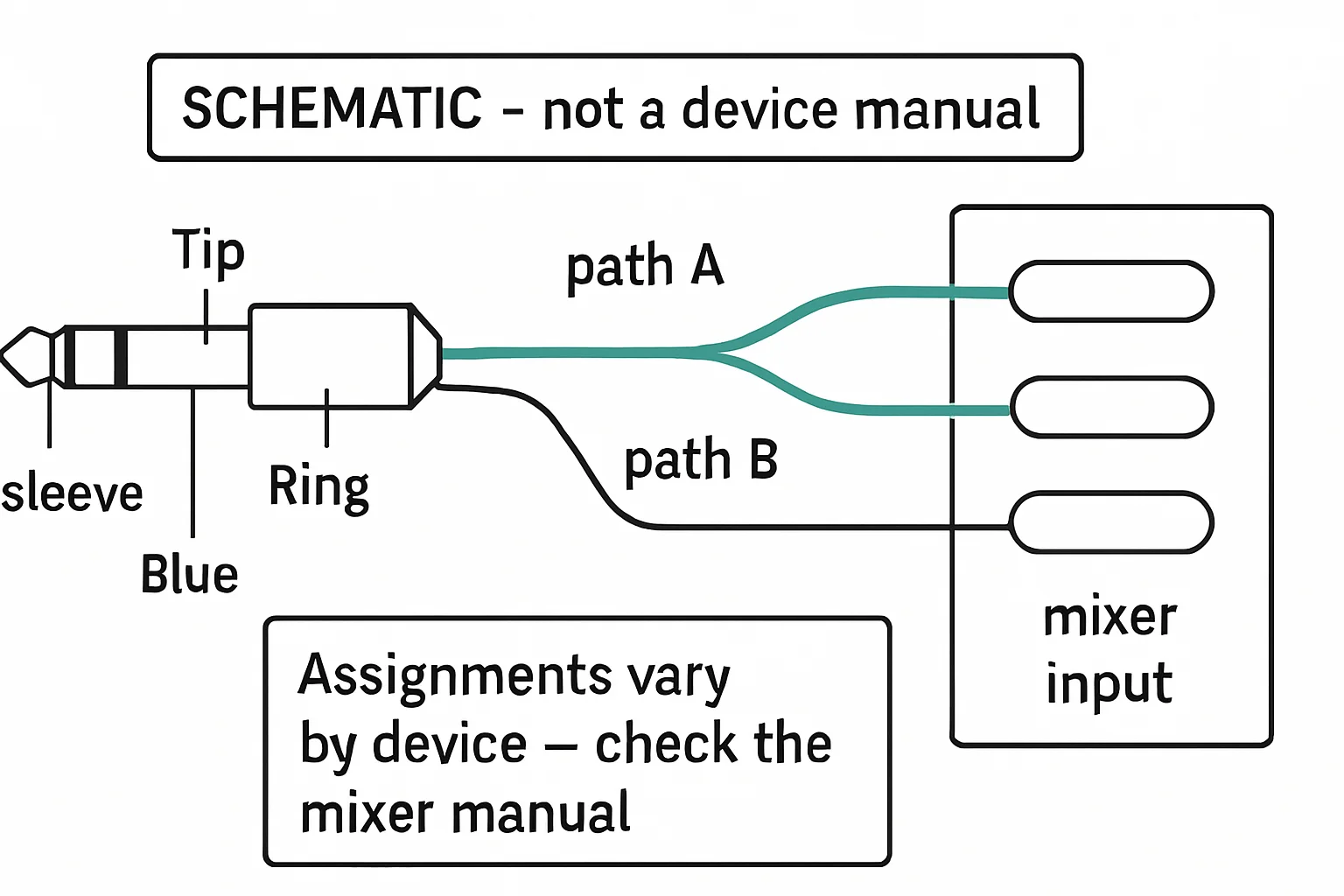
PB-TRS35-TRS35). And then there is the mixer insert cable: TRS on one end, two TS on the other, with the single TRS connector doing two directions at once - tip carrying the send out, ring carrying the return back. That last one trips people up because the same plug that looks like a simple interconnect is actually a tiny two-lane road. A common convention treats tip as send and ring as return, but insert wiring is not as universally standardized as the other two - if you are building or buying for a specific mixer, check that mixer's manual against the cable's wiring diagram before you trust the convention.
How the mismatch sounds
This is where the plug-as-shell problem turns into real damage on a gig. Plug a balanced-mono TRS output into an unbalanced stereo input and the ring's inverted signal cancels the tip's against ground - you get thin, hollow, phasey audio that sounds almost right and fails silently. Nobody calls you to the booth to say it is broken; they just say something sounds off all night. Plug a stereo TRS feed into a balanced mono input and one channel disappears entirely. Both failures look correct on the outside. The connectors seat, the signal meters move, and the problem hides until someone actually listens.
The quickest physical check only gets you halfway: a 1/4-inch TS plug (like the Neutrik NP2X) has two bands, a TRS plug (like the Neutrik NP3X) has three. But band count tells you the number of contacts, never the wiring. For the wiring, you need the cable's diagram or its product page in the vault.
Stop guessing, start ohming
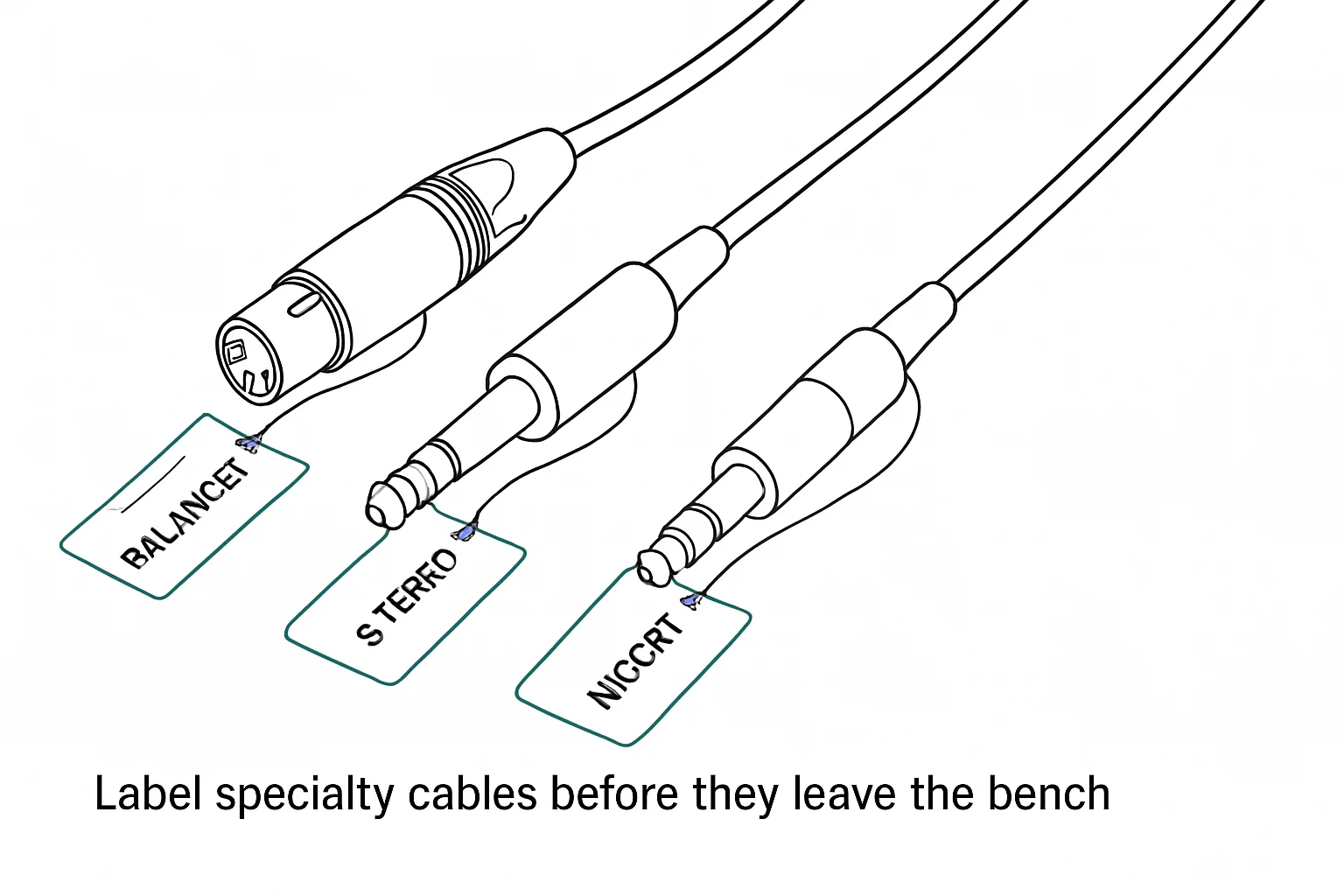
The bench habit that ends this confusion is embarrassingly simple: keep one known-good reference cable of each type on the bench, clearly labeled - BALANCED TRS, STEREO TRS, INSERT. When a cable's job is in doubt, ohm it out against the reference instead of guessing from the plug. It takes a minute, it settles every argument, and it is exactly the same discipline as verifying a meter before a continuity test: trust the instrument, the reference, and the wiring diagram - in that order - and never the connector's shape.
Bench takeaway: match the cable to the job, not the plug - and when the plug's job is a mystery, ohm it out.
Pinout reference
| Pin | Carries |
|---|---|
| T | Hot (+) |
| R | Cold (−) |
| S | Shield |
| Pin | Carries |
|---|---|
| T | Signal |
| S | Shield / return |
Related
Stop Using Mystery Cables: A Labeling System That Works · Your Cable Isn't a Garden Hose: Learn the Over-Under Coil · Course: Build a basic XLR cable