Bench Notes › Articles › Reference
Article · 1 min readPatch It Once. Understand It Forever.
By Thomas Popp · Oct 7, 2026

Patch It Once. Understand It Forever.
A patchbay with unlabeled looms is a puzzle box. Six months later nobody - including you - remembers what goes where, and every session starts with twenty minutes of tracing cables by hand while the talent waits.
Routing you can't read is routing you can't trust, and untrusted routing gets re-patched from scratch every time somebody new touches the room. The fix takes one afternoon and pays off for years.
Four fields per patch
Label source-to-destination on every patch, and keep one master patch list per room or kit. Each entry has four parts: source name and output number, cable ID, destination name and input number - e.g., "BOOM-OP MIC -> PB-XLRF3-XLRM3-25 -> CH07 CONSOLE." Four fields, one row per patch, and anyone can trace any signal without asking. The worksheet also needs a room or kit header and a revision date, because a patch list from before the last rebuild is worse than no patch list - it's confidently wrong. Tape the current revision inside the case lid or pin it above the rack, where the work happens, not in a drawer.
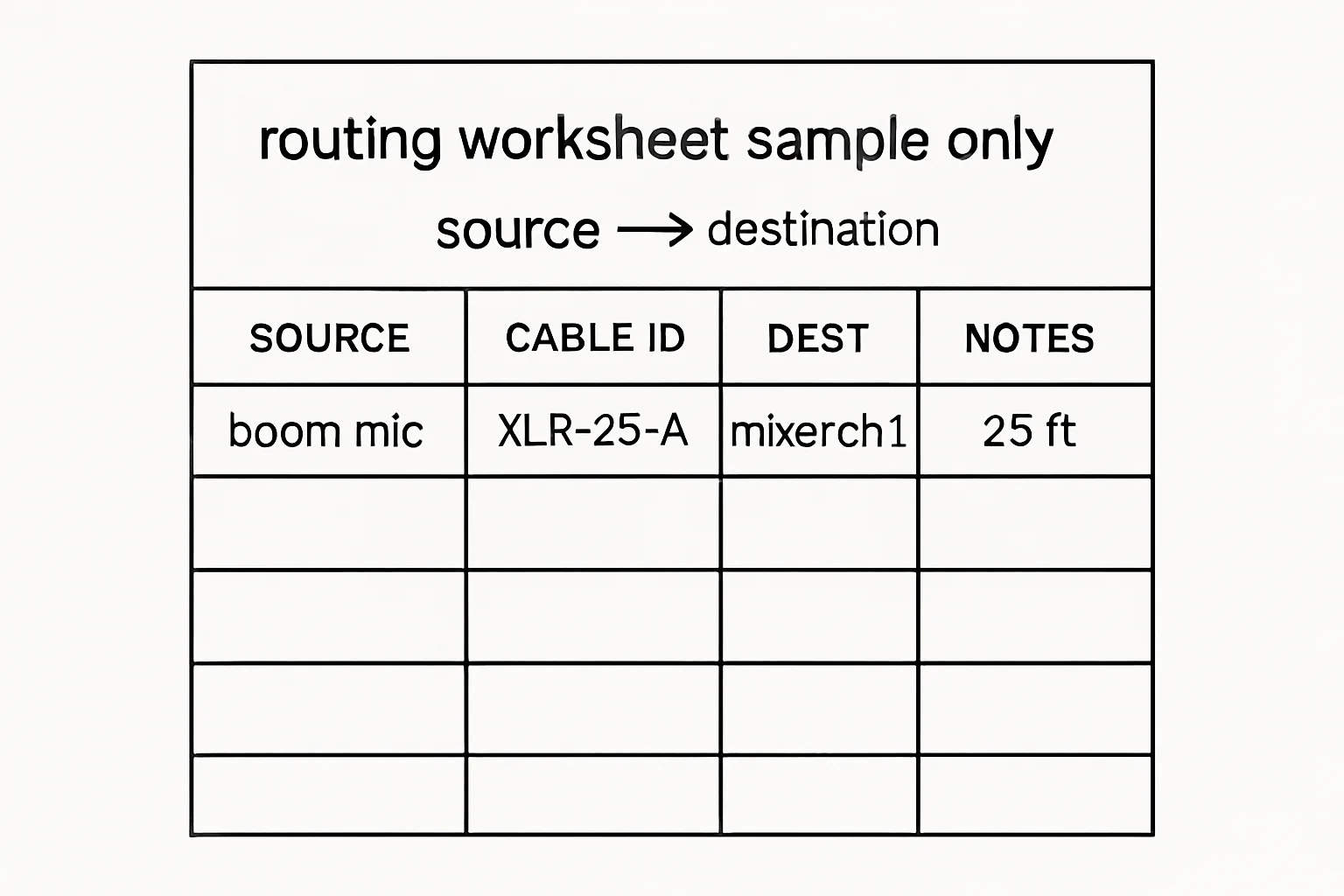
Name roles, not people
Three conventions make a patch list hold over time. First: name sources by role, not by person - "BOOM-OP,"
not "Tom's mic." People rotate off projects; roles stay, and a list full of names becomes archaeology within a semester. Second: number everything at the patchbay, and keep those numbers stable across revisions so "CH07" means the same input every time. Third: tag both ends of the cable with its ID. A cable labeled at only one end is half a cable when you're tracing from the wrong side of the rack, and tracing from the wrong side is exactly when you need the label.
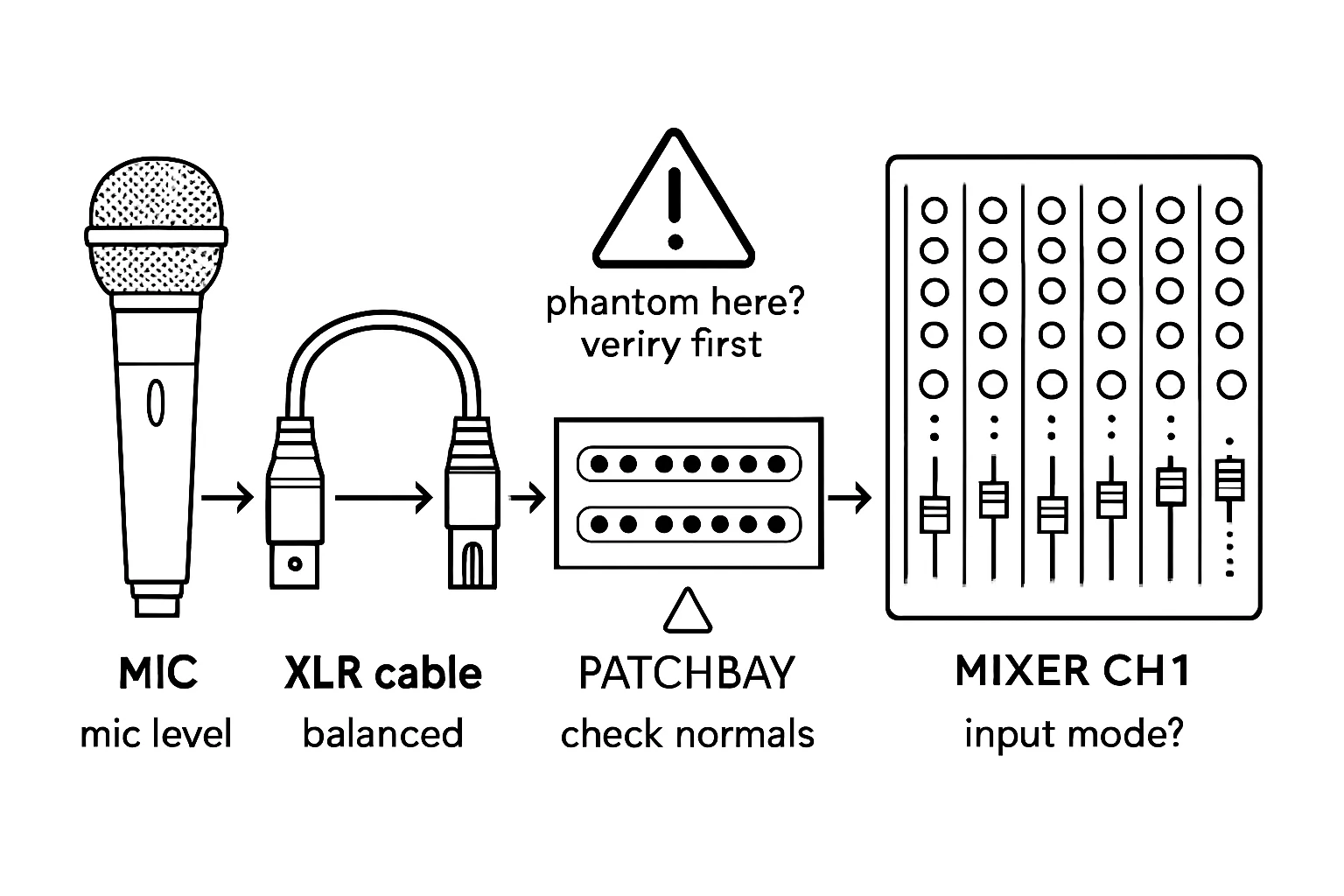
Let the cable ID do the reading
A real ID scheme is the backbone of the whole system. ProductionBench PB numbering tells you exactly what the cable is at a glance - PB-XLRF3-XLRM3-25 reads as a standard mic cable, 25 feet - so you never guess a cable's identity from its color or its length on the floor. When the ID is on both ends and the patch list uses the same IDs, tracing is a lookup, not an investigation. This is also what makes the patch list maintainable: a new patch is four fields and a tag, not a research project.
Keep the sheet alive
The minimal patch list that gets updated is better than the perfect one nobody maintains. The rule is simple: if the sheet doesn't get updated when the patch changes, it's decoration. Make the update take thirty seconds - a blank row, four fields, a tag - or it won't happen. The person who re-patches at 11 PM is the person who has to write it down, and they will only do it if the list is right there, taped inside the lid, with a pen that works.
Bench takeaway: four fields per patch, role names, numbered patchbay, tagged both ends, and the current list where the work happens - patch it once and anyone can trace it forever.
Related
Stop Using Mystery Cables: A Labeling System That Works · Your Cable Isn't a Garden Hose: Learn the Over-Under Coil · Course: Build a basic XLR cable