Bench Notes › Articles › Wireless
Article · 1 min readMove the Antenna Before You Replace the Microphone.
By Thomas Popp · Oct 7, 2026
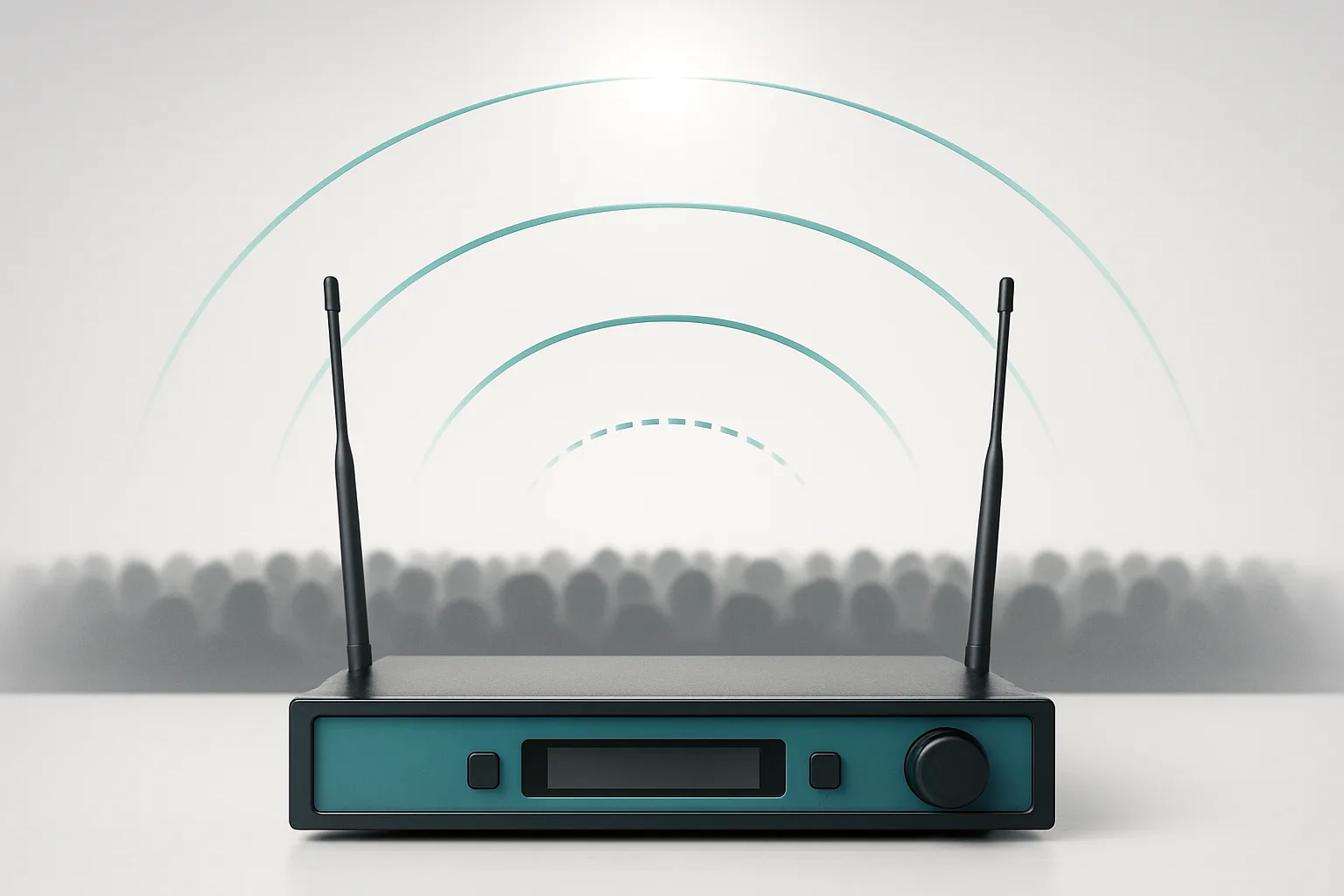
The audio cuts out and the instinct is to swap the lav. New capsule, new mic, different transmitter - and the dropout follows the talent wherever they go. But if the mic is fine on the bench and failing on the set, the weak link is the RF path, not the capsule. The mic is a passenger on a radio link, and the radio link is only as good as the two antennas at its ends. The fix is free, and it takes seconds: move the antenna before you replace the microphone.
The talent is the obstacle
Start with the thing nobody wants to hear: the human body is a large bag of salt water, and salt water absorbs RF. A bodypack buried under layers of clothing against the talent's skin turns the wearer into a signal absorber. The antenna is radiating into the actor's torso instead of toward the receiver.
On set this sometimes means a conversation with wardrobe, which is exactly why the sound department needs that conversation early rather than at the first dropout.
Metal is the second obstacle
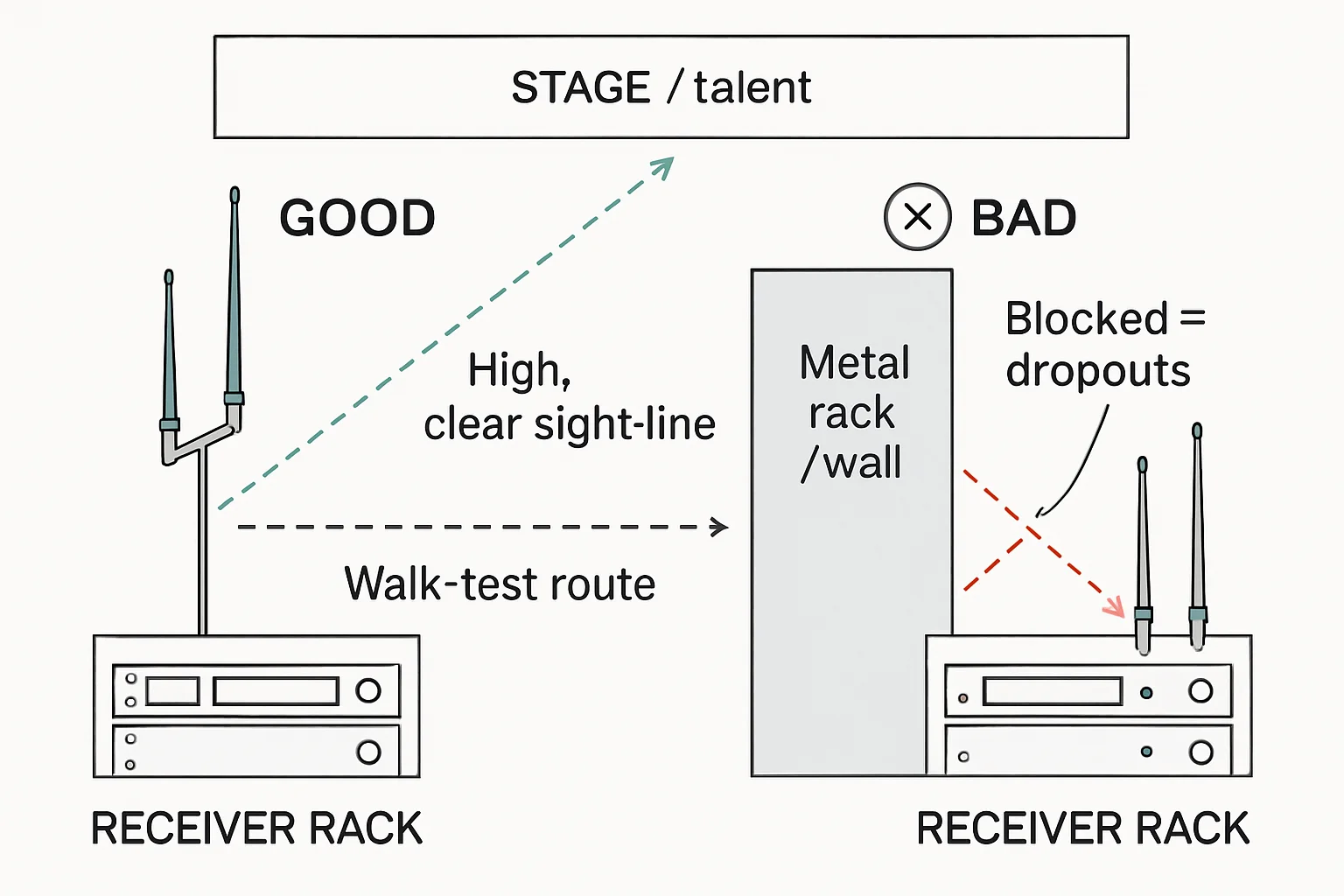
Keep the whip antenna away from metal: belt buckles, equipment racks, metal furniture, and anything else reflective in the signal's way. Metal doesn't absorb RF the way a body does - it reflects and blocks it, and an antenna pressed against a buckle or a rack is effectively detuned by the metal sitting in its near field.
The same thinking applies at the receiver end. Give the signal a clear path where you can: transmitter and receiver with line of sight, or as close to it as the set allows. When the receiver lives in the sound cart at video village, the whole set - walls, furniture, moving bodies - sits between the antennas. Moving the cart's receivers even a few feet, or getting them up higher and clear of the cart's own metal frame, can change a marginal link into a solid one. Nothing about the transmitter changed; only the geometry did.
Know your antenna, follow its manual
Not all bodypack antennas are the same hardware, and they don't all want the same treatment. Some bodypacks carry fixed wire whips - the Lectrosonics SM series is the classic example - where the antenna is a permanent wire that should hang free and unbent. Others carry detachable quarter-wave antennas on SMA connectors, like the Shure AD1 or Deity bodypacks, where the antenna is a separate stick that screws on.
For the specifics of how each one should sit - orientation, clearance, positioning relative to the body - go to that manufacturer's manual. Antenna orientation specifics are standard RF practice in the field, but the vault's verified manual entries don't prescribe a universal angle, so the bench rule is: the maker designed it, the maker's guidance wins. Don't substitute forum wisdom for the manual.
Check the antenna's health
Before you start repositioning, look at the whip itself. A bent, kinked, or loose whip costs you range - the radiating element is damaged, and no amount of clever placement fixes a broken radiator. On fixed wire whips, a kink is permanent damage; protect it during packing and transport. On detachable SMA antennas, check the
connector: seat it and finger-tighten it. Hand-tight, never with pliers - an SMA over-torqued with a wrench cracks the connector or strips the threads, and then you have a new problem that no amount of repositioning will solve. A loose SMA that backs off during a block is a classic creeping failure: fine at call time, dropping by lunch. It takes two seconds to check during the preflight.
Bench takeaway: The RF link is only as good as its antennas - keep the whip off the body, clear of metal, healthy, and seated, and follow the manufacturer's placement guidance before you suspect the mic.
Related
Stop Guessing Your Wireless Frequencies · Was That an RF Dropout or an Audio Connection Failure? · Course: Build a basic XLR cable