Bench Notes › Articles › Test
Article · 1 min readFive Things to Check Before Putting Cables Back in the Case.
By Thomas Popp · Oct 7, 2026
The end of a show is when cable damage is freshest and easiest to spot - and it's also when everyone's in a hurry. Cables go back in the case damaged, and the damage waits weeks to be discovered on the next setup, on the clock. Two minutes per cable at wrap saves you a failure on set. Here are the five checks.
1. Connector damage
Look for bent or missing pins, cracked shells, corroded contacts. Green on the metal means clean it or retire it a corroded contact won't fix itself in the case. Check the shell, too: a cracked or loose shell is a connector that's one bad pull away from coming apart in someone's hand.
2. Jacket condition
Cuts, nicks, crushed spots, and any place the jacket has pulled away from a connector boot. The jacket is the armor - a breach in it is where the next failure starts, and it's cheapest to deal with when you catch it now instead of discovering it mid-show. A jacket pulling away from a boot is a cable that's about to start flexing its conductors where they can't take it.
3. Contamination
Paint, tape residue, mud, food - anything on the jacket or in the connector. Contamination glues the next setup together, gums up connectors, and inside a connector it can short a contact. Wipe it off at wrap while it's fresh. Dried-on residue is a different, much harder problem, and it's a problem you chose by leaving it.
4. Loose hardware
Set screws, backshells, strain relief - anything that rattles or spins. Tighten what's loose, and note what won't tighten. A shell that spins freely is a connector whose internals are taking movement they weren't designed for, and a set screw that's backing out is a connector that's disassembling itself one show at a time.
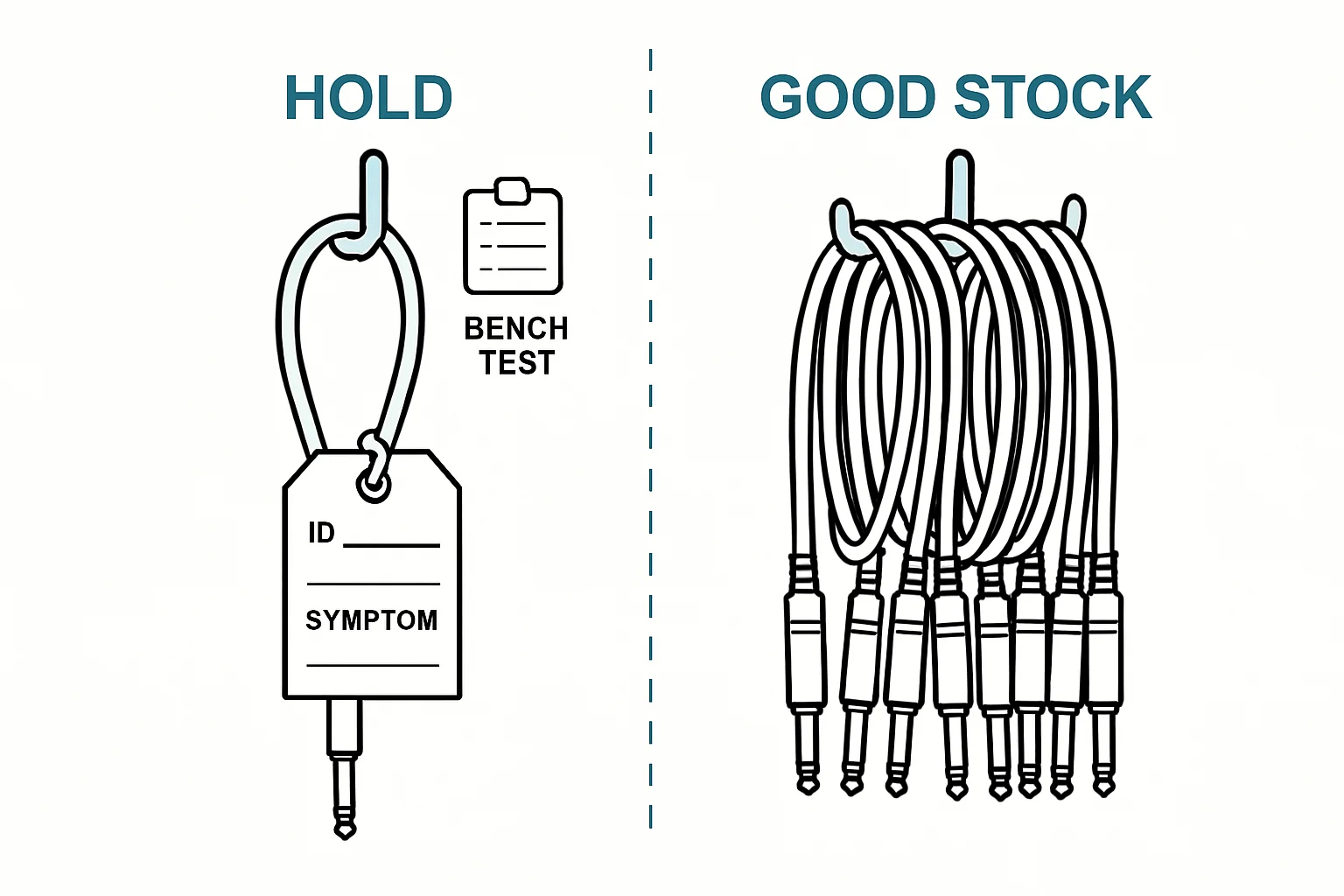
5. Flag it for retest
Any cable that behaved even slightly oddly on the show gets marked and set aside for a full inspection and flex test - not tossed back into the inventory. "Slightly oddly" is the bar: a dropout you couldn't reproduce, noise that came and went, a connector that felt loose but held. Mark it now, while the memory is fresh, because next week nobody will remember which cable it was.
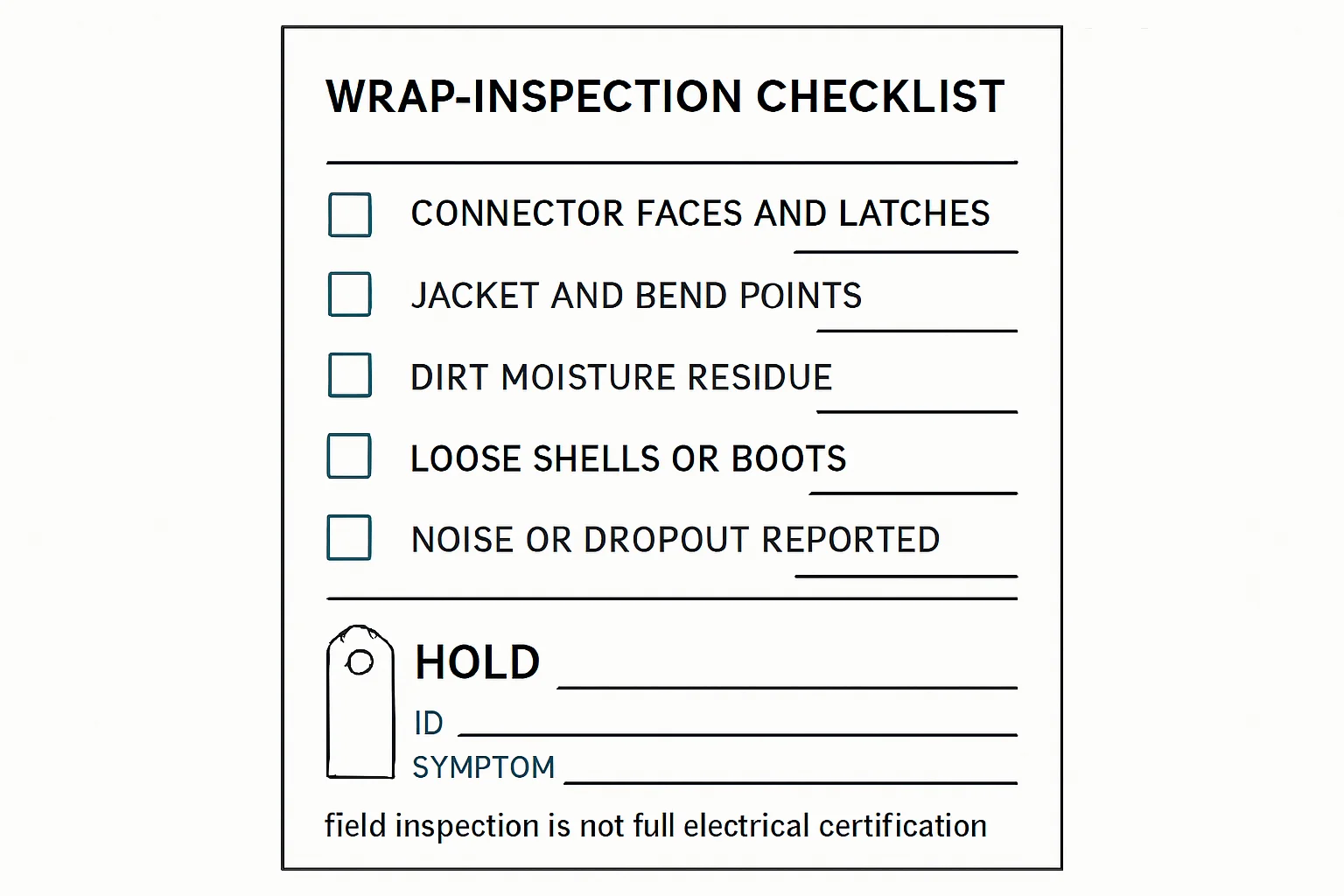
Run it at the coil, not the case
Do these five checks as you coil each cable, not when it reaches the case. Once it's packed, nobody opens the case to look again until the next show - and by then, two minutes at wrap has turned into a troubleshooting session on the clock. The coil is the last moment the cable is in your hands. Use it.
Bench takeaway: Two minutes per cable at wrap - connectors, jacket, contamination, hardware, flag the odd ones - run at the coil, not the case.
Related
Your Cable Looks Fine. So Why Doesn't It Work? · The Wiggle Test: Catching a Cable That Only Fails Sometimes · Course: Build a basic XLR cable